
Health guide
Colon cancer: symptoms, screening from 45 and diet
Colon cancer is a cancer that starts in the large intestine, often from small growths called polyps, and together with rectal cancer it's known as colorectal cancer. Common symptoms are a change in bowel habits, blood in or on the stool, ongoing belly pain and weight loss without trying, but early colon cancer often causes no symptoms. That's why the US Preventive Services Task Force recommends screening for adults from age 45 to 75; screening can find polyps before they turn into cancer.
Updated Sources: CDC, NIH, medical societies
- Start screening
- Age 45
- Colonoscopy
- Every 10 years
- Stool test (FIT)
- Every year
- Under 50
- Rates rising
Colon cancer symptoms
The CDC lists these symptoms of colorectal cancer:
- A change in bowel habits
- Blood in or on your stool
- Diarrhea, constipation, or feeling that your bowel doesn't empty all the way
- Belly pain, aches or cramps that don't go away
- Weight loss you can't explain
- Low iron in your blood (anemia)
Other conditions, such as hemorrhoids or infections, cause many of these too. Only a doctor can tell the difference, so talk to one about any symptom, whatever your age. Don't wait for your screening date.
Screening from age 45
The USPSTF recommends colorectal cancer screening for adults 45 to 75 at average risk. From 76 to 85, the decision depends on your health and past screening. Several tests work; the best one is the one you'll actually do:
| Test | How often |
|---|---|
| Stool test (FIT or high-sensitivity gFOBT) | Every year |
| Stool DNA-FIT | Every 1 to 3 years |
| CT colonography | Every 5 years |
| Flexible sigmoidoscopy | Every 5 years (or every 10 with a yearly FIT) |
| Colonoscopy | Every 10 years |
A positive stool or CT test needs a follow-up colonoscopy. If you have a family history of colorectal cancer or polyps, inflammatory bowel disease or an inherited syndrome such as Lynch syndrome, your doctor may advise starting earlier or testing more often.
Risk factors
- Age: risk rises with age, though colorectal cancer has been rising in people under 50 (by 2.9% a year from 2013 to 2022, per the American Cancer Society) for reasons not yet clear.
- Family or personal history of colorectal cancer or polyps.
- Inflammatory bowel disease (ulcerative colitis or Crohn's disease).
- Lifestyle: excess body weight, a diet high in red and processed meat, smoking, alcohol and low activity.
Diet and activity habits that may help
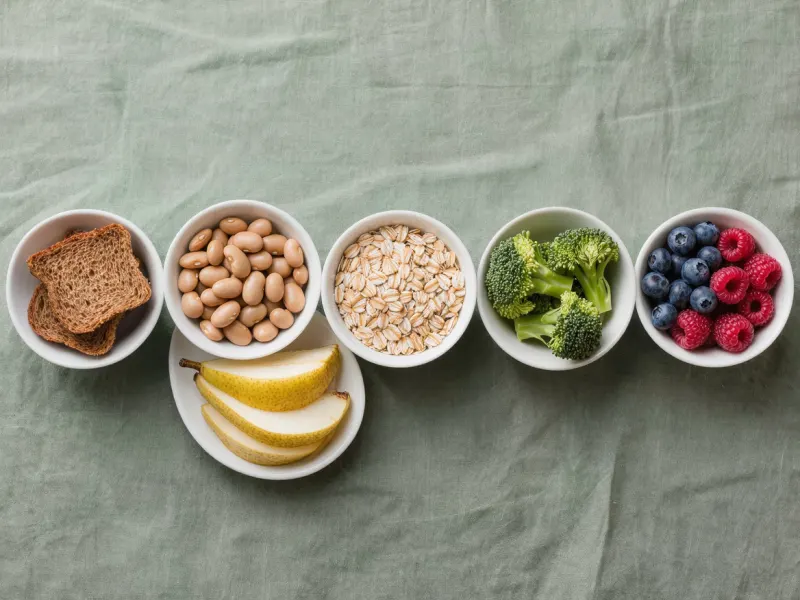
The American Cancer Society says eating more vegetables, fruit and whole grains and less red and processed meat probably lowers risk. Fiber-rich foods are part of that pattern, though fiber's exact role is still being studied.
- Fill up on plants: vegetables, fruit, beans and whole grains such as oats and brown rice (see gut health for easy ways to add variety).
- Limit red and processed meat: swap some steak, bacon and deli meat for fish, chicken, beans or lentils.
- Move more: more, and more vigorous, activity is linked to lower risk; a full body workout or brisk walks both count.
- Keep a healthy weight, especially for men, in whom the link looks stronger.
- Skip or limit alcohol: the American Cancer Society says it's best not to drink; if you do, no more than 1 drink a day for women or 2 for men.
- Don't smoke.
Sources
Frequently asked questions
What are the early signs of colon cancer?
Early colon cancer often has no symptoms. When signs appear, they include a change in bowel habits, blood in the stool, ongoing belly pain and weight loss without trying; see a doctor about any of these.
At what age should you get a colonoscopy?
The USPSTF recommends colorectal cancer screening from age 45 to 75 for people at average risk. Colonoscopy is one option, every 10 years; stool tests are another.
Is a stool test as good as a colonoscopy?
Both are recommended options. Stool tests are done at home more often (FIT every year), and a positive result needs a follow-up colonoscopy; talk with your doctor about which suits you.
Does red meat cause colon cancer?
A diet high in red and processed meat is linked to a higher risk, according to the American Cancer Society. Eating less of them and more plants probably lowers risk.
Why is colon cancer rising in young adults?
Rates in people under 50 have risen for years, and the reasons aren't yet clear. This is one reason screening now starts at 45 and why symptoms at any age should be checked.
This guide is general health information, not medical advice, and can't diagnose any condition. If you have symptoms or questions about your health, talk to a doctor. In an emergency, call 911 or your local emergency number.